“Custom” doesn't mean complicated
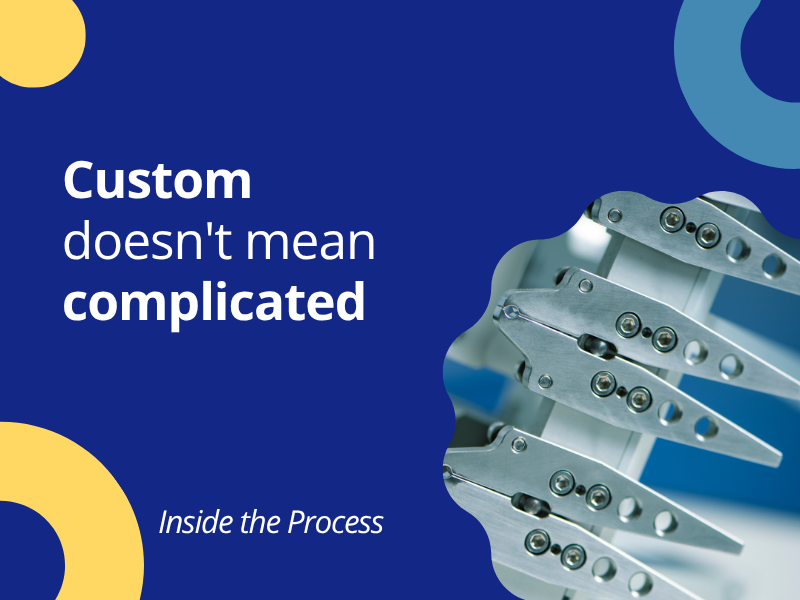
When it comes to customized automation, the term “custom” may bring to mind a machine designed from scratch—one that is complex and difficult to replicate.
In reality, customization does not necessarily mean adding complexity.
In many production processes, an effective solution stems instead from a balance between what can be standardized and what must be adapted to the specific characteristics of the product, process, or line.
A machine can therefore be based on established technologies, components, and solutions while integrating elements designed to meet specific needs: a different product configuration, a specific assembly sequence, an additional control, or integration with systems already present on the line.
It is precisely this balance that makes customization a tool for optimization—and not necessarily a source of greater complexity.
In the case of single-use medical device manufacturing, this need is particularly relevant. Processes may share similar stages and technologies but differ in terms of geometries, materials, components, controls, or production requirements.
For this reason, the choice of an automation solution should be based on the actual process and its variables, evaluating which elements should remain standard and which need to be adapted.
Tecnoideal develops both standard semi-automatic machines for individual workstations and customized automation systems designed to meet specific customer needs. Customization thus becomes part of a design approach that aims to integrate technology and process without introducing unnecessary complexity.